
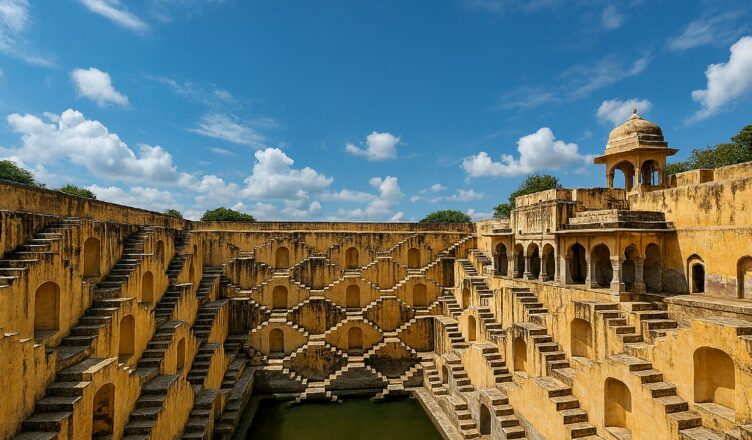
Jaipur’s Historical Stepwells
Stepwells were once used to store and manage groundwater. However, these elegant structures became obsolete due to other methods of water storage. Today, out of the 600-plus stepwells in Jaipur, only a few remain in good condition. Let’s explore details about four stepwells that have historical architecture.
Panna Meena Ka Kund
Located in Amer town near Jaipur, this eight-story stepwell is well restored. It was constructed during the 16th century. Stairs have ample space to sit. And local legends suggest it was a place for women to sit and chit-chat during summer. All four corners have pavilions. The zig-zag design ensures people can reach water during all seasons. It has a network of limestone stairs on three sides. And there is a room on the northern wall used for religious ceremonies.
Chand Baori
The monument is located in Abhaneri village. So, also known as Abhaneri stepwell. It is one of India’s largest stepwells. Green parrots and other birds greet you as you enter its premises. The historical architecture has a diamond-like pattern with 3500 steps that take you 13 stories down. Ornate carvings on various parts will keep your eyes glued for hours. The stepwell is square in appearance. There are cascading staircases on three sides, while the fourth side has a raised platform for Harshat Mata Temple.
Nahargarh Stepwell
Nahargarh Stepwell can store a huge amount of water. Its asymmetrical design and irregularly designed steps differentiate it from other stepwells. The monument was constructed along with the fort by Maharaja Sawai Jai Singh II in 1734. Located inside Jaipur’s Nahargarh Fort, the stepwell’s design ensures water flows in from all directions. Stairs are only on two sides, unlike other stepwells. And steps become bigger and narrower in some places. Hindi film Rang De Basanti’s song ‘Apni Pathshala’ was filmed at this location.
Sarai Bawari
Sarai Bawari is located on Jaipur-Amer road. Historical documents indicate this was used as a resting place by traders and travelers during the 16th to early 17th century. The rectangular-shaped stepwell is estimated to be more than 400 years old. It has steps on only one side. The structure is three stories deep and has a hard rock base. The design ensures immediate replenishment. It never overflows. The well was extensively cleaned, and restored by Coca-Cola in 2006.
Jaipur relied on stepwells to harvest monsoon rainwater for drinking, rituals, and irrigation. Thus, these structures hold significant importance in the region’s culture. Don’t forget to explore these historical architecture pieces during your Jaipur tour. You can check the available Jaipur tour packages on HostMyTrips.